The Rise of the Forward-Deployed Engineer
The Art of Making AI Actually Work
While companies chase AI benchmarks, a quiet revolution is happening in who they hire to make AI actually useful.
There's a hiring war happening in AI, and it's not for the people you'd expect.
While most attention still goes to model performance benchmarks and infrastructure cost optimizations, companies like OpenAI, Anthropic, and Cohere are quietly hiring a different kind of talent: Forward-Deployed Engineers (FDEs). Job listings for these roles have grown more than 800 percent in the last year. OpenAI plans to send 50 FDEs across Europe this year. Anthropic is multiplying its applied AI team by five.
This signals a shift in how the industry thinks about AI adoption.
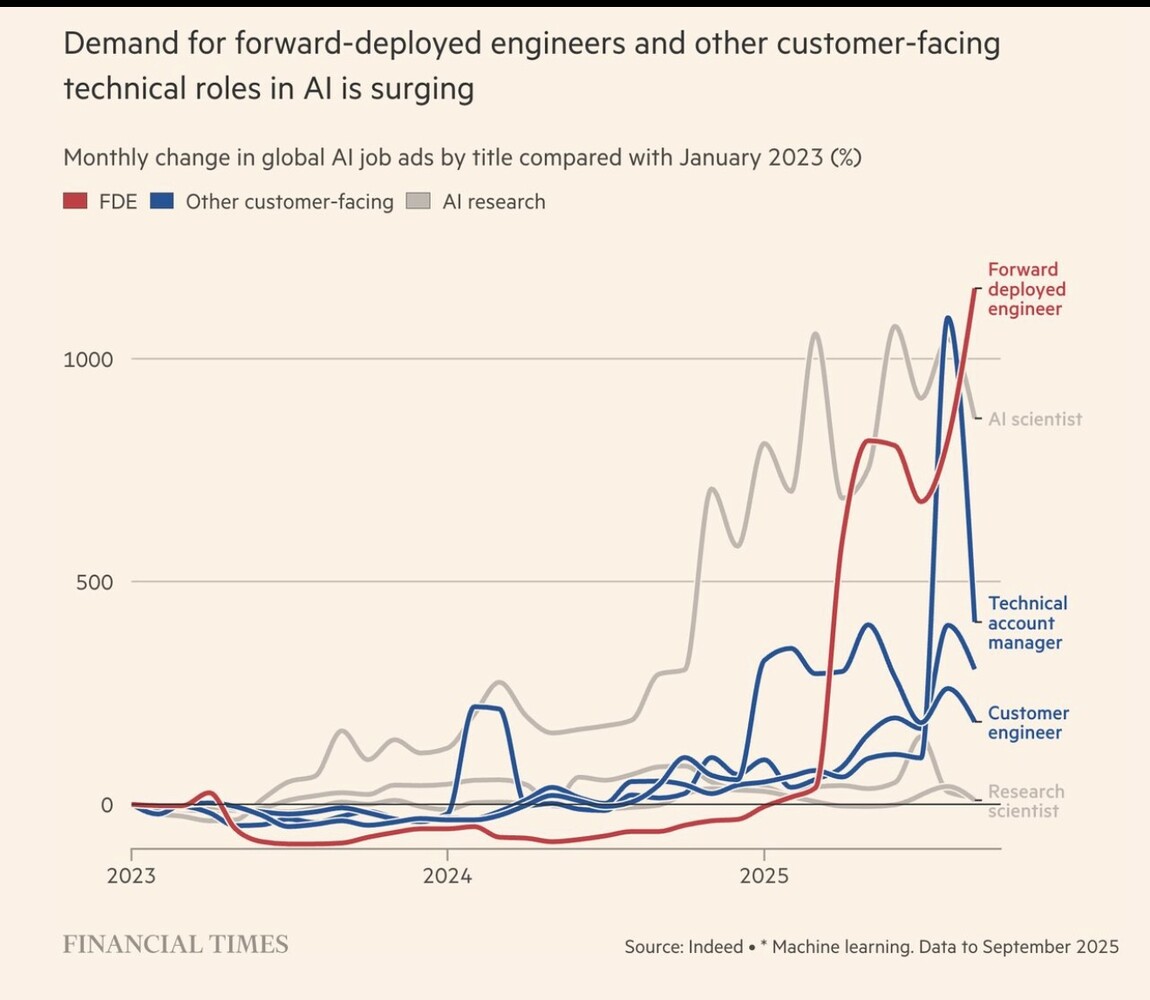
What is a Forward-Deployed Engineer?
A forward-deployed engineer is a technical contributor embedded inside a client or user environment. They collaborate directly with stakeholders to understand domain-specific constraints, uncover practical needs, and adapt general-purpose tools into tailored solutions. FDEs are not building from a distance. They work side by side with teams to make AI usable where it actually matters.
The Implementation Gap
Here's what's happening inside a lot of companies.
They license Claude, GPT-4, or Gemini. They see great demos. They imagine dramatic use cases. Six months later, no one's using it. The models are fine, but the AI feels generic, the workflows clunky, and the promised impact is nowhere.
Why?
Because real businesses don't operate in clean environments. They have legacy systems, compliance requirements, process friction, and non-technical users with very specific language and needs. The model might work in theory. But in context, it fails.
ChatGPT for agricultural equipment? Useless out of the box.
Claude for medical documentation? Close, but not compliant.
Gemini for cybersecurity? Promising, but too brittle.
FDEs step into this gap. Not just to write code, but to understand what's broken and why.
Not Just Software Engineers
The best FDEs are technical, but that's not all they are. They succeed because they know how to translate between what the model can do and what the users actually need.
They think about systems, not just codebases. And they don't assume better tooling means better outcomes.
John Deere
When OpenAI deployed engineers to John Deere, they didn't just tune prompts. They spent time on farms. They learned the economics of chemical use, soil health, and regional climate. Only then did they adapt the model to reduce spraying by 60 to 70 percent without hurting yield.
Novo Nordisk
At Novo Nordisk, engineers worked alongside regulatory, clinical, and IT teams to rework documentation workflows, reducing a 10-week process to minutes. This happened not just because the model got smarter, but because the people did.
The Skills That Matter
This isn't about being a full-stack dev who can drop into a meeting. It's about hybrid skills:
- 1Empathy with real users
- 2Pattern recognition across messy workflows
- 3Architecture judgment
- 4Patience to iterate without perfect data
- 5Strong communication between technical and business teams
You pick up these skills by being there, sitting with users, following their workflows, understanding the details they don't write down. It builds slowly through real projects and real constraints.
Palantir Did This First
Palantir pioneered this approach over a decade ago. They put engineers on military bases, factory floors, and oil rigs. Not to do discovery, but to deliver working tools. Today, half their company operates this way.
They proved it then. The AI world is catching up now.
Consultants Can Do This Too
The obvious problem is that most companies can't hire full-time forward-deployed talent. It's expensive. The talent is scarce. And the need is real today.
That's where consultancies like Jinka step in.
We work like embedded FDEs without the overhead. Our engineers join your team, map your workflows, identify integration points, and turn AI from promise to practice.
What We Bring
A Forward-Deployed Engineer Approach.
Our engineers join your team for a period of time so they can see how your work is organized, what slows you down, and where the real opportunities are. This approach lets us design systems that make sense for your environment instead of giving you something generic.
Context-aware AI integration.
We start from your processes, not from models. We build automation, tools, and decision systems that align with how your teams work.
Data systems that scale.
From pipeline design to infrastructure, we make sure your data is ready to support AI that grows with you.
Fractional technical leadership.
Need a strategic eye? We also offer fractional CTO services to help you prioritize, budget, and build toward AI adoption that actually sticks.
Whether you need to rescue a failing AI rollout or want a second brain in the room for a critical internal build, we're ready to help.
Our consultants bring forward-deployed engineer experience, embedding with your team to turn AI from promise to practice.